
Bee Em See…, B.M.C…. : Revisiting BMC With Some Spirituality… !
– Faith-Consciousizing a popular method of business model generation
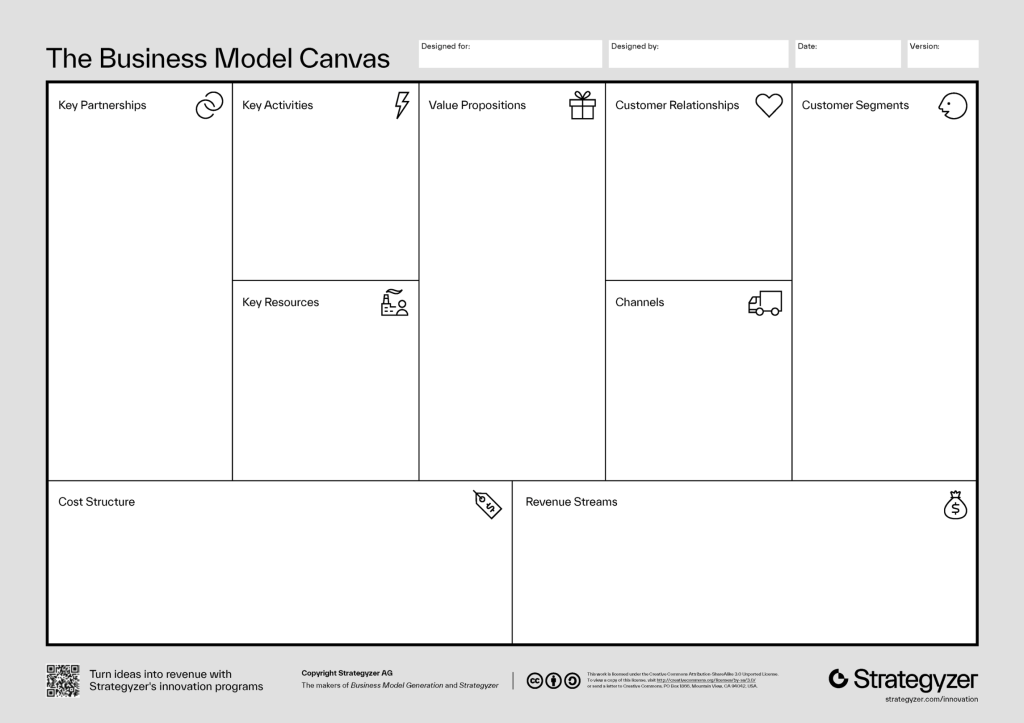
BMC here refers to the Business Model Canvas. On a single canvas (page), you get to view nine building blocks of a business. Many strategists, consultants and entrepreneurs use it as a practical, visual tool to design and iterate their business model.
See it mentioned (with a twist) in this short video below, in a recent meetup of Faith-Conscious Professionals:
(If you can’t view the video above, click here.)
In that masterclass on Islamic Entrepreneurship, George Bohlender from Dragonfire Corporate Solutions Sdn Bhd included a spiritual perspective of BMC!
In this newsletter edition, I share (with George’s permission) the “Islamic BMC” template found in his course material and I attempt to interpret and discuss what it means to see the BMC through a faith-conscious lens.
I hope to participate in the entire Islamic Entrepreneurship masterclass in future. For now I revisit the BMC, requesting guidance from George, my other BMC mentors and readers here. I stand corrected, and welcome your comments so that my own BMC can be updated and refined, insha Allah.
NINE BLOCKS OF BMC EXTENDED TO THIRTEEN
The original Strategyzer BMC looks like this:
George’s Islamic Entrepreneurship version expands it thoughtfully:
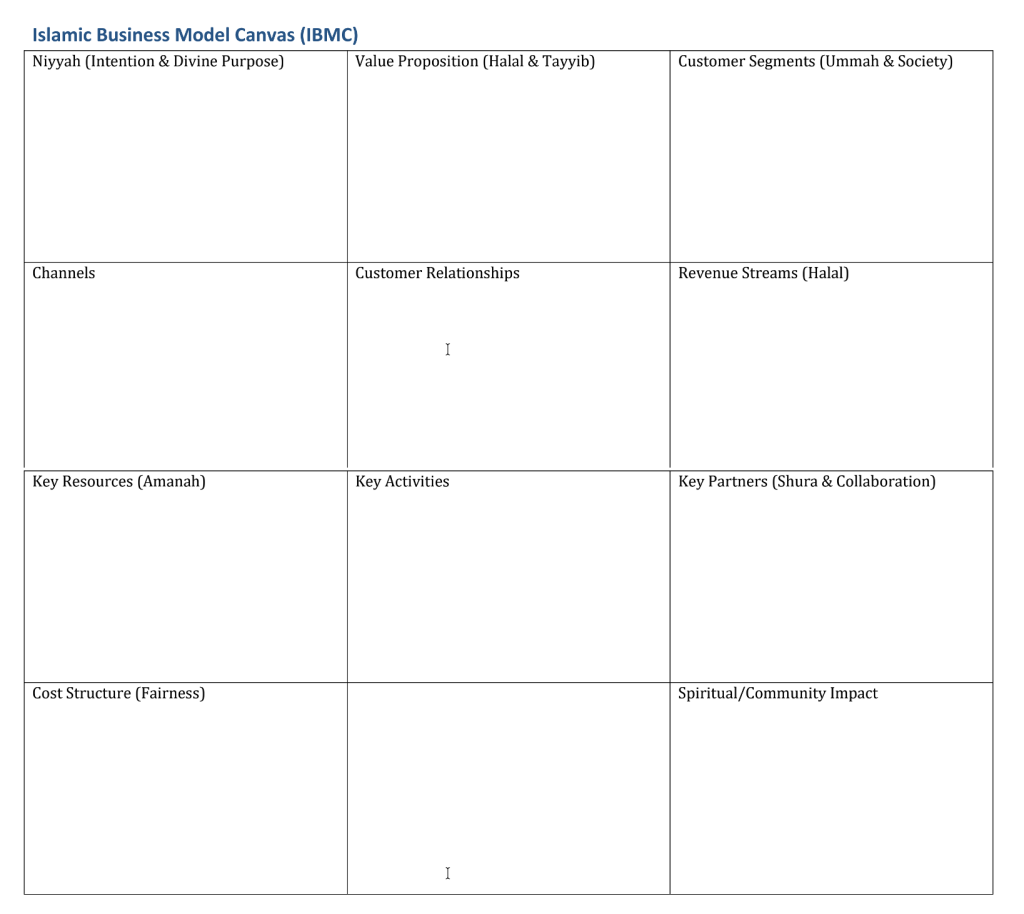
Two new blocks are introduced:
- Niyyah (Intention & Divine Purpose)
- Spiritual/Community Impact
Six of the original nine blocks also receive additional spiritual anchoring:
- Value Proposition (Halal & Tayyib)
- Customer Segments (Ummah & Society)
- Revenue Streams (Halal)
- Key Resources (Amanah)
- Key Partners (Shura & Collaboration)
- Cost Structure (Fairness)
These expansions open up new conversations about how we design, operate and measure our businesses or professional practice.
There is much to unpack, so I focus on five highlights that stood out for me.
FAITH-CONSCIOUSIZING THE BMC: FIVE HIGHLIGHTS
⓵ Niyyah (Intention & Divine Purpose)
The Prophet ﷺ taught us that actions rise from intention.
The BMC begins with “Who do we serve?” and “What value do we create?”
A faith-conscious BMC begins even earlier: Why am I doing this in the sight of Allah?
Niyyah guides us long before revenue models or customer segments.
In my coaching work, I often see leaders gain clarity from quiet re-alignment to higher-level purpose. Niyyah settles the heart, which then settles the strategy.
Questions this block asks:
- What is the highest purpose behind this venture or service?
- Whom does Allah want this work to benefit?
- How do we protect sincerity while aiming for excellence?
When niyyah is clear, the other blocks on the canvas become grounded.
⓶ Value Proposition (Halal & Tayyib)
A value proposition usually answers:
- What problem do we solve?
- What value do customers gain?
The Islamic BMC adds two filters: Halal (permissible) and Tayyib (wholesome, good, beneficial).
It becomes a check on purity of offering and purity of impact.
Tayyib also reminds us that the quality of value matters, not only the benefit.
In practice, this can mean:
- services delivered with sincerity, clarity and fairness
- avoiding harm even when the market allows it
- ensuring our “value” does not manipulate or mislead
I have seen consultants, corporate leaders and small business owners reframe their offerings beautifully when asked: Is this truly tayyib for the people who will receive it?
⓷ Revenue Streams (Halal) – and RIZQ!
This block doesn’t mention Rizq (sustenance) in the title. Rizq is my own additional consideration when I look at revenue and finance. I would like to extend “business model” to beyond “How we make money.”
While halal (permissible) revenue is reminded, the additional spiritual dimension I remind myself is that Rizq comes from Allah, and it comes in many forms.
In some of my own work, like experimenting with pricing generosity models (scholarship, PIF [Pay It Forward], PWYC [Pay What You Can]), I learned that trust in Allah expands Rizq in ways strategy alone cannot predict, including in non-monetary rewards, e.g. seemingly unrelated ease in other parts of life.
Questions to explore here:
- Is the revenue source halal?
- Can the income structure possibly bring barakah (divine blessing and multiplication)
- Does my heart rely on Allah, or on the model I designed?
Faith-conscious revenue planning introduces calmness into strategy. The heart participates, not only the calculator.
⓸ Key Resources (Amanah)
Strategyzer defines resources as assets that enable delivery: skills, knowledge, technology, capital, networks.
The Islamic BMC adds Amanah (divine trust).
Resources are not possessions. They are trusts.
Amanah invites us to ask:
- How do I honour my strengths, time, health, credibility and relationships?
- How do I care for the people who work with me, when I treat them as “People as Amanah” beyond “HR”?
- How do I avoid waste, burnout or exploitation?
In many coaching sessions, leaders discover that their most strained resource is not money. It is emotional bandwidth, attention and trust.
Seeing resources as amanah leads to khalifah/stewardship patterns that improve well-being, team morale and the sustainability of the enterprise.
⓹ Spiritual/Community Impact
This is the most beautiful addition. The original BMC ends with cost and revenue. The Islamic BMC extends the canvas to include:
- “What does this work contribute to people, society and the ummah (whole community)?”
- “What spiritual imprint does this leave behind?”
This block feels like the canvas’s akhirah (hereafter) lens.
Examples include:
- spreading beneficial knowledge
- elevating ethical standards
- developing people
- strengthening families
- reducing harm
- enabling sadaqah jariyah (continuous charity)-like impact
Even a small business can have a large spiritual footprint when intention aligns with service.
Many of my clients have experienced a sense of renewal when they realise that their business is not only an engine of income but an engine of good. They begin to lead differently, speak differently and plan differently.
FROM BLOCKS TO HEART CHAMBERS
Models and canvases help us structure our thinking. The Islamic BMC invites us to structure our hearts as well.
It proposes a simple view: Beyond an economic and financial undertaking, business is a field of worship.
I encourage myself and you to sketch your canvas with that approach, then insha Allah, our decisions will change. We become more careful with intention and more generous with impact. We balance strategy with sincerity and refine plans with humility.
I hope this revisiting of the BMC method shines some light to let faith illuminate our business gently.
If you do update your own canvas, share with me your thoughts.
We learn together and rubah (tramsform/reform) our models together, insha Allah.
