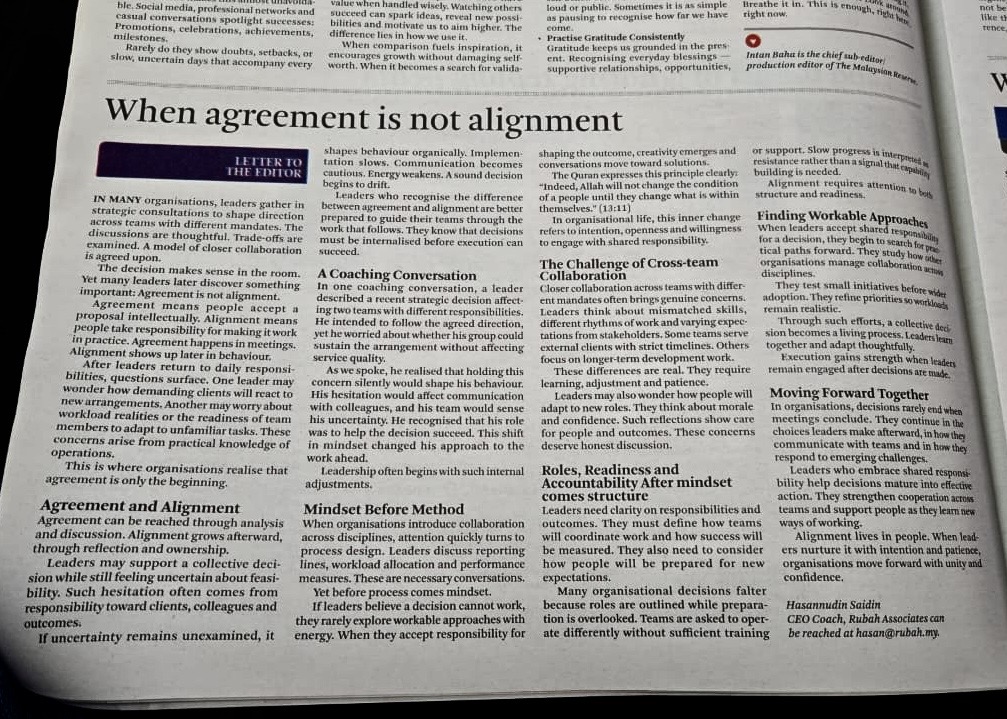
IN MANY organisations, leaders gather in strategic consultations to shape direction across teams with different mandates. The discussions are thoughtful. Trade-offs are examined. A model of closer collaboration is agreed upon.
The decision makes sense in the room. Yet many leaders later discover something important: Agreement is not alignment.
Agreement means people accept a proposal intellectually. Alignment means people take responsibility for making it work in practice. Agreement happens in meetings. Alignment shows up later in behaviour.
After leaders return to daily responsibilities, questions surface. One leader may wonder how demanding clients will react to new arrangements. Another may worry about workload realities or the readiness of team members to adapt to unfamiliar tasks. These concerns arise from practical knowledge of operations.
This is where organisations realise that agreement is only the beginning.
Agreement and Alignment
Agreement can be reached through analysis and discussion. Alignment grows afterward, through reflection and ownership.
Leaders may support a collective decision while still feeling uncertain about feasibility. Such hesitation often comes from responsibility toward clients, colleagues and outcomes.
If uncertainty remains unexamined, it shapes behaviour organically. Implementation slows. Communication becomes cautious. Energy weakens. A sound decision begins to drift.
Leaders who recognise the difference between agreement and alignment are better prepared to guide their teams through the work that follows. They know that decisions must be internalised before execution can succeed.
A Coaching Conversation
In one coaching conversation, a leader described a recent strategic decision affecting two teams with different responsibilities. He intended to follow the agreed direction, yet he worried about whether his group could sustain the arrangement without affecting service quality.
As we spoke, he realised that holding this concern silently would shape his behaviour. His hesitation would affect communication with colleagues, and his team would sense his uncertainty. He recognised that his role was to help the decision succeed. This shift in mindset changed his approach to the work ahead.
Leadership often begins with such internal adjustments.
– Aligning decisions through thoughtful consultation
STRATEGY BEGINS WITH ALIGNMENT
This week’s theme in the newsletter is Faith-Inspired Strategy: applying Qur’anic and Prophetic wisdom to vision, decisions and direction. When we think about strategy, we often think of plans, targets and analysis. Yet strategy begins earlier — in the conversations through which people align around a direction.
Across many years of facilitation and leadership work, I have been present when groups were trying to decide important matters together. I have seen this in strategy retreats, corporate task-force meetings, coaching sessions, community committees, and when chairing the inaugural executive committee meeting of a residents association. The settings differ, yet the intention is similar. People care deeply about their responsibilities, and still clarity does not always come easily.
Over time I realised that strategy depends not only on expertise. It depends on how we listen and speak before deciding. When dialogue is shaped with care, alignment becomes possible. Alignment does not mean everyone prefers the same option. It means people understand the reasoning and can move forward responsibly together.
The Qur’an reminds us about consultation as a way of life:
“…and whose affairs are conducted by consultation (shura) among themselves…” — Qur’an 42:38
Shura is not merely a meeting. It is a discipline of thoughtful dialogue that shapes strategy.
GOING DEEPER INTO A PRACTICE
Recently, The Malaysian Reserve published my article, Strengthening Decisions Together: A Modern Shura. That article introduced the idea briefly. In this edition, I would like to go deeper into the practice itself.
Through facilitation work, corporate project meetings, mastermind circles, and family discussions, a simple dialogue approach gradually took shape. I call it Strengthening Decisions Together, or SDT. The name reflects a deliberate observation: we strengthen outcomes by strengthening decisions together.
WHY STRATEGY NEEDS DESIGNED DIALOGUE
In many organisations and communities, people are sincere (ikhlas) and capable (qadir). Yet meetings sometimes drift because the decision question is not clearly named, assumptions remain unspoken, or responsibility is not clarified. Without structure, conversation becomes tense or circular. With tactful structure, dialogue becomes more composed and clearer.
Designed dialogue does not remove differences of view. It helps people understand one another before moving forward. When understanding grows, trust grows. When trust grows, alignment becomes possible.
Alignment is not consensus. It is a shared willingness to move forward with a decision that has been thoughtfully considered.
The “infinite scroll” mechanism was engineered (by Aza Raskin, who later regretted it) using slot-machine psychology. It removes cues for stopping. It keeps the thumb moving. It rewards unpredictability.
Indeed, design influences behaviour. Digital environments shape spiritual states.
So a faith-conscious leader must ask. What is this environment shaping within me? Where is my attention being trained?
THIS IS ABOUT ATTENTION
Not all phone use is the same.
Purposeful research, communication, structured learning — these are intentional.
Zombie scrolling is directionless (ghafla), compulsive engagement. Awareness fades and time dissolves.
Neuroscience suggests rapid, unpredictable content creates dopamine spikes. When stimulation becomes frequent, baseline motivation shifts. Ordinary tasks feel heavier. Deep reading requires effort. Salah (prayer) requires presence that feels harder to access.
This touches something deeper than productivity.
Attention is amanah (sacred trust). The heart follows where attention settles.
A CRISIS OF MEANING
On-the-surface solutions circulate widely: delete the app, install a blocker, or reduce screen time.
Structure can help. I’ve tried.
Subboor Ahmad proposes that it is direction that determines sustainability. When purpose clarifies, behaviour follows.
If you have a journey to catch in the morning, preparation shapes your night; you won’t be scrolling past midnight.
If you are entrusted with responsibility, your schedule reflects it.
Subboor describes zombie scrolling as a crisis of meaning. That language resonates deeply within our tradition. Allah says:
“And the worldly life is not but amusement and diversion; but the home of the Hereafter is best for those who fear Allah. So will you not reason?” — Qur’an 6:32
The Qur’an speaks of amusement and diversion as temporary engagements that can eclipse higher purpose.
IN MANY organisations, meetings consume energy without necessarily strengthening decisions.
Over the years, I have facilitated several strategic retreats. In one instance, in a single afternoon, we worked through five major strategic items: Three unit plans and two cross-functional initiatives. Time was limited. The personalities in the room were strong. The issues under discussion carried real weight.
What emerged was a disciplined way of engaging — one that treated strategy not merely as planning, but as responsibility.
We practised what I call strengthening decisions together.
The intention was straightforward: When a proposal is presented, the shared task is to strengthen it. Every decision carries consequences beyond the meeting room.
Framing discussion this way shifts the posture of participants.
Designing the Dialogue
Each presenter is actually a proposer. The presentation included stating the purpose of the initiative and what success would look like. Colleagues asked clarifying questions to ensure shared understanding.
Only after that did participants offer strengthening inputs. These also cover identifying risks, assumptions, blind spots or areas requiring sharper articulation.
The tone of these inputs mattered. They were framed as care for the work entrusted to the team.
There was no voting. Each proposal went through one round of integration. The presenter having considered the inputs is able to adjust or clarify the original proposal, or park the inputs for further work. Items requiring leadership direction were surfaced openly. Then we moved forward.
In that single afternoon, five strategic conversations unfolded with focus and shared ownership. Strategies became clearer. Dependencies surfaced. Accountabilities were sharpened. The discussions carried discipline and intent.
Participation widened. Voices that might otherwise remain reserved surface to contribute. Strong personalities engaged with deliberation. Contributions became measured and purposeful.
In the Islamic tradition, this inner orientation is addressed through the concept of niyyah, or intention, which invites reflection on what one is acting for and why that action is being taken (Pic credit: MEDIA MULIA)
Leadership effectiveness is shaped by factors that are less easily measured and yet deeply consequential
IN TODAY’S leadership environment, visibility and output are closely watched. At the start of the year, targets matter and performance indicators are decided upon and assigned. Leaders are assessed through results, activity and responsiveness.
These are part of organisational life. However, leadership effectiveness is shaped by factors that are less easily measured and yet deeply consequential. How leaders show up shapes how leadership is experienced.
In meetings, conversations and moments of uncertainty and demands for change, instead of constant activity to get results, leadership is also demonstrated through presence. This means attentiveness, steadiness and tone. It is these qualities that influence trust, judgement and the ability to navigate complexity.
Presence has become an important leadership capability in environments shaped by constant motion and competing demands.
The Cost of Constant Performance Mode
Many leaders operate for seemingly never-ending periods in performance mode. They move quickly from one obligation to another, appear outwardly effective, yet still feel internally stretched. Over time, this affects listening, discernment and the quality of engagement with others.
Decisions are made under pressure. Conversations become transactional. Reflection is rarely done. These patterns accumulate and shape leadership outcomes in ways that are not always immediately visible.
This is where presence becomes relevant as a leadership discipline.
EMOTIONAL intelligence has become a familiar concept in leadership and organisational development. Ideas such as emotional regulation, self-motivation and self-awareness are now widely regarded as essential capabilities for effective leadership.
Yet this language is relatively recent. When I began working in the 1980s, emotional intelligence had not yet entered leadership vocabulary. It gained prominence in the 1990s and became mainstream in the 2000s.
As these ideas developed, I found much to appreciate in modern psychology. It helped leaders recognise the role emotions play in judgement, relationships and performance. At the same time, I sensed that a deeper foundation already existed, waiting to be rediscovered rather than newly invented.
That clarity emerged through the work of Muhammad Javed, whose exploration of emotional intelligence through the Prophetic tradition offered coherence and depth.
His work demonstrates that principles now associated with emotional intelligence were already embedded in Islamic teachings, especially in the practice of Prophet Muhammad (PBUH) long before they were labelled as such.
This rediscovery carries important implications for leadership today.
Emotional Regulation as Moral Alignment
One of the central elements of emotional intelligence is emotional regulation. In leadership settings, this involves managing reactions, maintaining composure and responding with deliberation, especially under pressure.
Within the Prophetic tradition, emotional regulation is understood as alignment with a moral and spiritual framework that is already established.
The Quran and the Sunnah (“habit,” “tradition” or “path,” referring to the way of life, teachings, actions and approvals of Prophet Muhammad) provide guidance on how emotions are to be recognised, disciplined and expressed.
Anger, fear, hope and desire are acknowledged as part of human experience and leaders are taught how to direct them with wisdom.
This perspective brings clarity to leadership practice. Regulation becomes an act of returning to values that are clearly defined rather than searching endlessly for new behavioural formulas. Leaders are guided by a stable reference point that anchors their responses during moments of stress or uncertainty.
In organisational life, such anchoring produces steadiness. Leaders who regulate emotions through values and faith offer consistency, especially when teams face volatility and change.
As the year unfolds, leaders should pause for self-examination, reflecting on the habits, assumptions and inner beliefs that shape their decisions, so that new goals are pursued with clarity, steadiness and purpose
LETTER TO THE EDITOR
Appeared in print edition of TMR (The Malaysian Reserve) on 29th December 2025.
We review strategies, budgets and calendars. This ritual is familiar and necessary. Yet experience suggests that renewal rarely succeeds when it begins with plans alone.
Sustainable renewal begins with a shift in paradigm.
A paradigm is an assumption or mental model through which we see ourselves, others and the world around us.
It shapes what we notice, how we interpret events and what we believe is possible. In leadership, paradigms quietly influence decisions, energy and behaviour long before any strategy is written down.
In my work as a CEO coach, I often meet capable leaders who feel stuck despite having skills, experience and good intentions.
The obstacle is rarely a lack of knowledge or effort. More often, it is an unexamined paradigm that keeps them operating within invisible limits.
That paradigm does not live in spreadsheets or frameworks. It lives in the heart.
Why the Heart Matters in Leadership Renewal
When we speak about the heart, we do not mean only the physical organ, though my own triple bypass surgery earlier this year certainly brought fresh appreciation for it.
In this context, the heart refers to the inner centre of perception, intention and meaning. It is where beliefs settle, where fears and hopes coexist and where trust or hesitation quietly form.
In the Islamic tradition, the heart (qalb) is central to human consciousness and moral orientation. It is described as the seat of understanding and discernment. When left unattended, distortions form gradually and become normalised.
The Prophet Muhammad (peace be upon him) said, “Indeed, in the body there is a piece of flesh. If it is sound, the whole body is sound. If it is corrupted, the whole body is corrupted. Truly, it is the heart.”
For leaders, this insight has practical consequences. Without inner clarity, outer change becomes short-lived or exhausting. Renewal that bypasses the heart eventually loses momentum.
Muhasabah: The Gateway to Paradigm Shifting
A powerful practice for inner renewal is muhasabah, or honest self-examination. It is a form of personal stocktaking that looks inward with truthfulness and compassion. It involves recognising patterns without self-attack, guilt or shame.
This is the eighteenth edition of The Faith-Conscious Leader.
I began this newsletter dreaming of some vague end. (“Let me get to 52 weeks first!”)
I did start with why.
Earlier this year, I emerged from a medical tribulation that slowed me down physically and inwardly. Reclamation (read: recovery) has a way of stripping away urgency and excess. What provoked me was a recurring question:
How do we lead, work and decide while remaining anchored in faith across everyday professional life?
This newsletter became a place for me to explore that question in public. I wrote as a learning practitioner reflecting in real time, shaped by coaching conversations, lived experiences and ongoing self-examination.
Writing weekly required steadiness, consistency, not to mention consumption of time! It required showing up with sincerity even when clarity was still forming. Over time, the writing became a discipline of attention and intention. Alhamdulillah (all praise and thanks be to Allah).
This final edition before a pause is a moment of stocktaking.
THE ARC OF THE JOURNEY
Looking back, these eighteen editions followed a progression that only became clear in hindsight.
The early editions focused on orientation.
I began by reflecting on leadership of the heart, identity and inner coherence. I explored how productivity systems, strategic language and professional frameworks influence behaviour and decision-making. Several editions examined how secular assumptions surreptitiously shape how we work, measure success and define effectiveness.
I deliberately went into application.
I explored faith-conscious productivity, bureaucratic realities, mission-driven strategy and leadership under pressure. I reflected on adversity through prophetic examples and personal experience, focusing on resilience, realism and responsibility.
The focus toggled outward-inward.
Several editions centred on stillness, emotional intelligence, renewal and purification of the heart. These reflections were grounded in conversations with leaders, community dialogues and personal struggle. They examined how emotional maturity shapes leadership presence and judgment.
The more recent editions moved assuredly into practice and structure.
Stocktaking (muhasabah) was introduced as an inward leadership discipline. The Business Model Canvas was revisited through a faith-conscious perspective. Paradigm shifting was explored as a prerequisite for renewal. Most recently, Anchored Goals translated inner clarity into a one-year planning structure grounded in roles, focus and steady review.
That most recent edition forms an important part of this journey. It connected renewal of the heart with practical goal-setting and showed how clarity can be sustained across twelve months through simple, repeatable practices.
Taken together, the editions traced a movement:
awareness
responsibility
reflection
renewal
structure
This sequence reflects how change unfolds in real leadership life.
– A faith-conscious goal setting for leaders seeking focus, steadiness and follow-through
FROM PARADIGM TO PRACTICE
In the previous edition, we explored how renewal begins with a paradigm shift in the heart. That inner shift matters because it determines what we choose to pursue, how we pursue it and how we respond when circumstances change.
This edition moves from inner clarity to practical structure.
Once the heart realigns, a natural question follows:
How do I translate this clarity into goals that guide my year without overwhelming me?
This is where the concept I call Anchored Goals comes in.
It is a way of setting goals that reflects the life we are actually living, the responsibilities we carry and the capacity we realistically have over twelve months.
WHY GOALS DRIFT WITHOUT ANCHORS
Many professionals set goals every year. Fewer feel guided by them.
From my coaching experience, goals tend to lose relevance when they are created without sufficient regard for the roles we live in daily, the energy each role requires and the emotional centre of the year.
When goals float without anchors, attention fragments, review becomes irregular and commitment weakens gradually.
Allah reminds us:
“So remain on a right course as you have been commanded…” — Qur’an 11:112
Anchored Goals begins by restoring structure and proportion, then shaping goals that fit within that reality.
STEP 1: CLARIFY THE ROLES YOU WILL BE PLAYING IN THE COMING YEAR
Before defining goals, we need to recognise the roles we already inhabit.
A role is an ongoing responsibility, not a glamorous title for status. It represents something that calls on your time, attention and emotional presence throughout the year.
Some roles are steady and do not require specific goals. Some have been neglected. Some are emerging.
Examples of roles leaders often carry include:
leader (CEO or senior executive)
entrepreneur or business owner
professional (manager, consultant, coach, facilitator)
spouse
parent
extended family member
learner
contributor to community
servant of Allah
self-caretaker
Make it deliberate to include self-caretaker as a role. Leaders often deprioritise health, renewal and inner development. Naming this role restores balance.
Limit your list to no more than eight roles. Combine or simplify where needed.
Then reflect:
Which roles currently receive most of my energy?
Which roles are under-attended?
Which roles will become more significant this coming year?
This step restores perspective. It allows us to see life as an integrated system rather than a collection of disconnected goals.
– How muhasabah (self-examination, stocktaking) helps leaders uncover self-limiting patterns and renew direction for the year ahead
WHY RENEWAL REQUIRES A PARADIGM SHIFT
It is December. As the year draws to a close, or when the new year has set in, many leaders reflect on goals, plans and targets for the year ahead. We review strategies, budgets and calendars. Yet I don’t recommend renewal to begin with plans alone.
It should begin with a paradigm shift!
The word paradigm is commonly used in leadership and strategy. It refers to an assumption, mindset or perception about yourself, someone else or a situation. It is the mental model through which we see the world. A paradigm shapes what we notice, how we interpret events and what we believe is possible.
“…Indeed, Allah will not change the condition of a people until they change what is within themselves…” — Qur’an 13:11
In my work as a CEO coach, I’ve observed that when leaders struggle to create results, they think the issue is lack of skill or effort. But then, the skills and knowledge they already have, are they really using them? Their efforts, how sincere are they about them?
What I see as the issue is a paradigm unconsciously holding them where they are.
And that paradigm does not live in spreadsheets or frameworks. It lives in the heart.
WHAT DO WE MEAN BY “HEART”?
When we speak about heart here, we do not necessarily mean the physical organ pumping the seen red blood, although an “overhaul” through my triple bypass surgery early this year did help! But then, beyond just being a pump, scientific research and physiological evidence suggest the heart plays an active role in mental and emotional processes.
In this article, we use heart to signify the inner centre of perception, intention and meaning. It is the “place” where beliefs settle. The place where fear, hope, trust and hesitation reside.
In the Islamic tradition, the heart (qalb) is central in the conception of the soul, not just an emotional organ but the pivot of consciousness and moral orientation. It is where understanding truly happens. It is also where distortions quietly form if left unexamined.
The Prophet ﷺ said:
“Indeed, in the body there is a piece of flesh. If it is sound, the whole body is sound. If it is corrupted, the whole body is corrupted. Truly, it is the heart.” — Hadith
This is why renewal for a new year must involve the heart. Without inner clarity, outer change becomes temporary or exhausting.
THE ROLE OF MUHASABAH IN PARADIGM SHIFTING
Muhasabah, or stocktaking, is the practice of honest self-examination. It includes truthful observation of pride (kibr), self-aggrandizement (ujub) or ostentation (riak), yet also without self-attack, guilt or shame.
It allows us to surface what is already shaping our actions, especially the patterns we have normalised.
For renewal to be real, muhasabah must go deeper than reviewing outcomes. It must address the question beneath performance:
CORE QUESTION: How do I limit myself and how can I stop?