
IQ → EQ → EI – Emotional Intelligence Through the Prophetic Lens
– How inner awareness and heart purification shape leadership with excellence, fairness and compassion
PROPHETIC MODEL OF EMOTIONAL INTELLIGENCE
Leadership with ihsan (excellence) calls us to lead with beauty of conduct, fairness and compassion. It is outer excellence grounded in inner clarity. Technical skills help leaders perform, but with tension or uncertainty, what sustains leadership is emotional steadiness.
Emotional intelligence has become a central idea in modern leadership. Yet long before it was labelled, Prophet Muhammad ﷺ lived its highest form.
Recently I viewed a meaningful conversation on The Barakah Effect Podcast, hosted by Faisal Abdul Latif and his team, featuring guest Muhammad Javed, author of the book Nurturing Emotional Intelligence: The Prophetic Path to Inner Harmony and Personal Growth.
Javed describes emotional intelligence (I use the acronym EI here) as about controlling one’s feelings and emotions, placing them in the driver’s seat of decision-making and behaviour, rather than being controlled by them. It encompasses internal factors like self-awareness, self-regulation, and self-motivation, as well as external factors such as social skills and empathy.
What modern psychology teaches about EI is valuable. What our prophetic tradition teaches goes deeper.
The video excerpt below from the podcast episode exemplifies the heart of prophetic EI:
(If you can’t view the video above, click here.)
Javed’s comprehensive study of the seerah (biography) of the Prophet ﷺ has revealed the Prophet ﷺ as the “gold standard” of EI, with the ability to adapt to any situation, emotionally intelligent in all aspects.
“Indeed, in the Messenger of Allah you have an excellent example for whoever has hope in Allah and the Last Day, and remembers Allah often.” — Quran 33:21
This newsletter edition reflects on four dimensions of EI that I saw emerged from the podcast conversation, guided by Qur’anic reminders and the examples of the Prophet ﷺ and other scholars. I hope this helps us shape our leadership with sincerity and compassion.
FOUR DIMENSIONS OF EMOTIONAL INTELLIGENCE
⓵ Self-Awareness: Knowing What Moves the Heart
A leader’s journey of increasing EI must begin with this first dimension of self-awareness. A muhasabah (stocktaking) exercise needs to be done to assess oneself against the three other dimensions below.
Modern EI definitions describe self-awareness as recognising one’s emotions, triggers and patterns. Our Islamic tradition asks our stocktaking to understand the states of the heart.
Gain self-awareness, then gradually develop a plan, setting small goals and seeking accountability through peers, accountability buddies, mentors, coaches or mastermind groups.
Self-awareness is the gateway to principled leadership.
⓶ Self-Regulation: Be Guided by Values Set by Allah
The contemporary model of EI looks at the need to be aware of your emotions and our values and we can have any value that we want, whatever is important to us.
For example, in self-regulation, what are some strategies to control anger? Perhaps think about whether a problem might be something we will be really be so angry about three or ten years from now. It’s a useful strategy but it’s even better if we combine that with the divine approach. The question becomes how we channel each of our emotions in the pleasure of Allah (versus the wishes of Shaitan).
Emotional regulation and impulse control control is about “objective morality,” and furqan (distinguishing good and evil), all laid down by Allah already!
Here’s another gold standard, specific to self-regulation exemplified by Ibn Taymiyyah in prison:
“What can my enemies do to me? My paradise, my garden are in my heart. Wherever I go, they are with me and never leave me. If I am imprisoned, I have seclusion for worship. If I’m killed, it is martydom. If they expel me from my land, it’s tourism.” — Ibn Taymiyyah
Self-regulation allows leaders to uphold boundaries, correct without belittling and navigate conflict with dignity. From an Islamic perspective, this part of purification of the heart. It protects us from harsh reactions and ego-driven decisions.
Leadership becomes more human when self-regulation strengthens sincerity.
⓷ Self-Motivation: Working With Purpose and Steadiness
Self-motivation grows when purpose becomes clear. Islam deepens this idea by tying purpose to accountability before Allah. This produces steady motivation that does not rely on external validation.
The podcast discussion noted the common modern phenomenon of instant self-gratification, that needs to shift to sacrificing for the long term, i.e. delayed gratification — towards the ultimate purpose of pleasing Allah and heading to Jannah (Paradise). This shift can be trained!
The call for sacrificing comes with high yaqeen (conviction, certainty) and comes with jihad (struggle, striving), including with our wealth:
“O believers!˺ March forth whether it is easy or difficult for you, and strive with your wealth and your lives in the cause of Allah. That is best for you, if only you knew.” — Quran 9:41
Leaders driven by sincere intention make their work becomes an offering to Allah. When challenges arise, they return to niyyah (intention). When progress slows, they reflect on why the work matters in the sight of Allah.
This form of motivation is consistent. It grows through gratitude, reflection and remembrance. Leaders with this steadiness become anchors for their teams in uncertainty.
⓸ Purification of the Heart: The Foundation of Emotional Maturity
This is the dimension that modern leadership often overlooks.
With self-awareness, self-regulation and self-motivation being three of the elements of EI in the model that Javed proposes, it is no wonder that self-purification becoming central to EI (see diagram below):
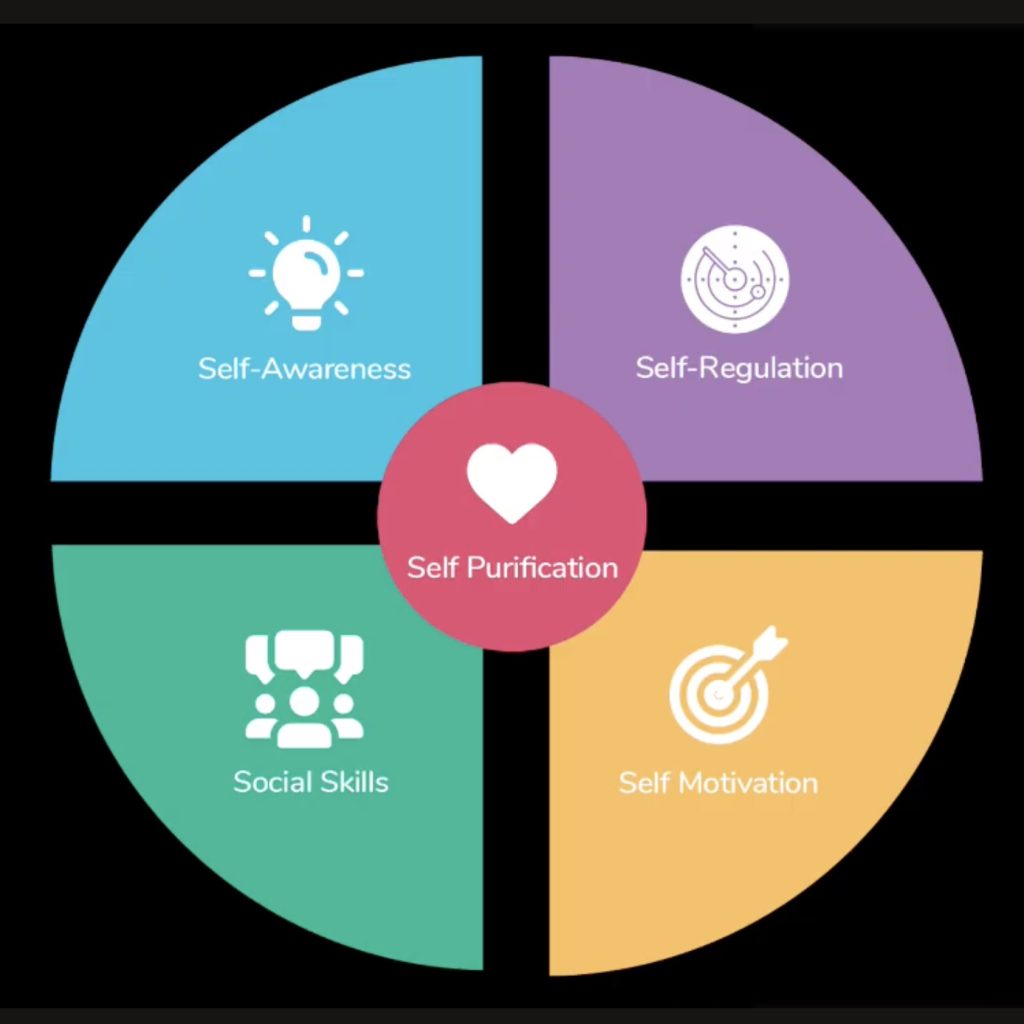
In the Islamic tradition, it is called tazkiyah al nafs (purification of the self) and tazkiyah al qalb (purification of heart [sou]) — distinct but sometimes used interchangeably.
Diseases of the heart such as envy, kibr (pride), resentment and insincerity cloud judgment. They influence decisions even when leaders believe they are acting rationally.
Purification is continuous. It involves reflection, repentance, gratitude and returning to Allah with humility. If there remain unresolved emotions, they are signals that the heart seeks clarity.
When leaders engage in this inward work, they carry less emotional weight. They speak with more presence. Their judgment becomes clearer and their compassion more authentic.
This is emotional intelligence shaped by ihsan (excellence).
EMOTIONAL INTELLIGENCE AS IHSAN IN LEADERSHIP
Emotional intelligence is often taught as a skillset. Our tradition presents it as a path of refinement. It asks us to polish the heart so that leadership reflects mercy, fairness and sincerity.
Leaders who cultivate awareness, calmness, intention and compassion shape healthy cultures. Difficult conversations become spaces of growth. Decisions and actions become grounded, not impulsive.
Leadership with ihsan begins inside. May Allah soften our hearts, strengthen our character and help us lead with beauty and justice. Aamiin.
CLOSING INVITATION
Connect with Muhammad Javed on LinkedIn here.
View the full podcast episode here (1 hour 45 minutes).
Watch Javed’s (free) strategic webinar on EI here (48 minutes).
Read Javed’s book Nurturing Emotional Intelligence: The Prophetic Path to Inner Harmony and Personal Growth.
Finally, if you would like to explore how Muslim professionals bring mercy, clarity and emotional maturity into their leadership, join our Faith-Conscious Professionals gathering. It is a space where we learn from Qur’an, Sunnah and lived experience how to lead with steadiness and ihsan.
Next session: Wednesday, 17 December 2025
LinkedIn Registration: https://www.linkedin.com/events/faith-consciousprofessionals-3r7396464938862600192/
Looking forward to seeing you there, insha Allah.
