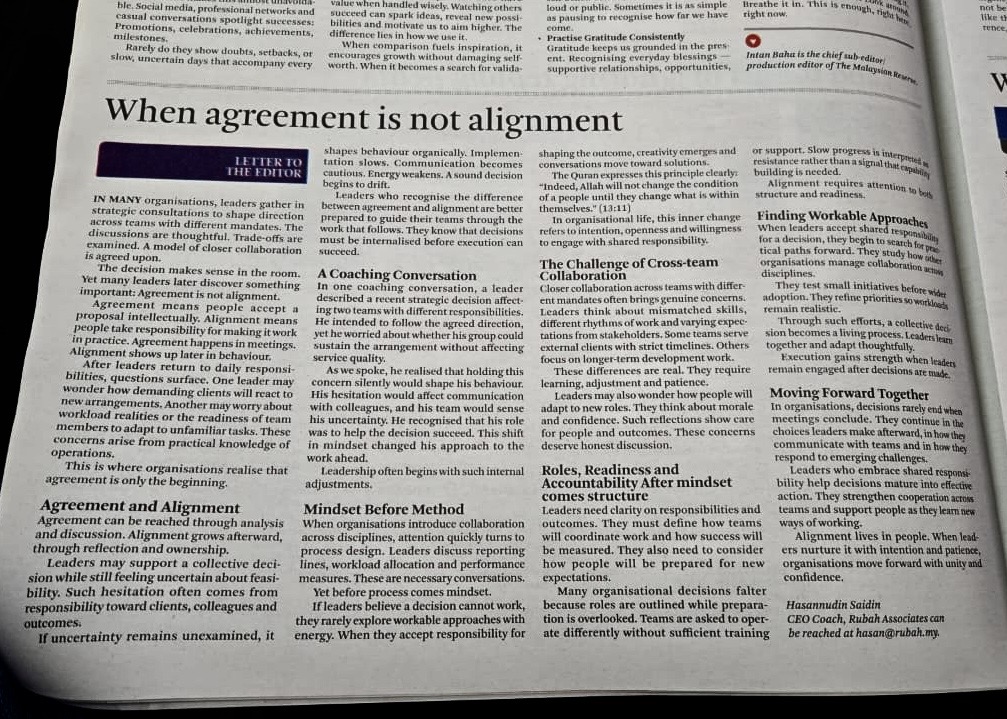
When agreement is not alignment

LETTER TO THE EDITOR
- Appeared in print edition of TMR (The Malaysian Reserve) on 23rd February 2026 – click for photographed copy.
- Appeared in online edition of TMR on 24th February 2026 – click to go to TMR online article.
IN MANY organisations, leaders gather in strategic consultations to shape direction across teams with different mandates. The discussions are thoughtful. Trade-offs are examined. A model of closer collaboration is agreed upon.
The decision makes sense in the room. Yet many leaders later discover something important: Agreement is not alignment.
Agreement means people accept a proposal intellectually. Alignment means people take responsibility for making it work in practice. Agreement happens in meetings. Alignment shows up later in behaviour.
After leaders return to daily responsibilities, questions surface. One leader may wonder how demanding clients will react to new arrangements. Another may worry about workload realities or the readiness of team members to adapt to unfamiliar tasks. These concerns arise from practical knowledge of operations.
This is where organisations realise that agreement is only the beginning.
Agreement and Alignment
Agreement can be reached through analysis and discussion. Alignment grows afterward, through reflection and ownership.
Leaders may support a collective decision while still feeling uncertain about feasibility. Such hesitation often comes from responsibility toward clients, colleagues and outcomes.
If uncertainty remains unexamined, it shapes behaviour organically. Implementation slows. Communication becomes cautious. Energy weakens. A sound decision begins to drift.
Leaders who recognise the difference between agreement and alignment are better prepared to guide their teams through the work that follows. They know that decisions must be internalised before execution can succeed.
A Coaching Conversation
In one coaching conversation, a leader described a recent strategic decision affecting two teams with different responsibilities. He intended to follow the agreed direction, yet he worried about whether his group could sustain the arrangement without affecting service quality.
As we spoke, he realised that holding this concern silently would shape his behaviour. His hesitation would affect communication with colleagues, and his team would sense his uncertainty. He recognised that his role was to help the decision succeed. This shift in mindset changed his approach to the work ahead.
Leadership often begins with such internal adjustments.
Mindset Before Method
When organisations introduce collaboration across disciplines, attention quickly turns to process design. Leaders discuss reporting lines, workload allocation and performance measures. These are necessary conversations.
Yet before process comes mindset.
If leaders believe a decision cannot work, they rarely explore workable approaches with energy. When they accept responsibility for shaping the outcome, creativity emerges and conversations move toward solutions.
The Quran expresses this principle clearly: “Indeed, Allah will not change the condition of a people until they change what is within themselves.” (13:11)
In organisational life, this inner change refers to intention, openness and willingness to engage with shared responsibility.
The Challenge of Cross-team Collaboration
Closer collaboration across teams with different mandates often brings genuine concerns. Leaders think about mismatched skills, different rhythms of work and varying expectations from stakeholders. Some teams serve external clients with strict timelines. Others focus on longer-term development work.
These differences are real. They require learning, adjustment and patience.
Leaders may also wonder how people will adapt to new roles. They think about morale and confidence. Such reflections show care for people and outcomes. These concerns deserve honest discussion.
Roles, Readiness and Accountability
After mindset comes structure. Leaders need clarity on responsibilities and outcomes. They must define how teams will coordinate work and how success will be measured. They also need to consider how people will be prepared for new expectations.
Many organisational decisions falter because roles are outlined while preparation is overlooked. Teams are asked to operate differently without sufficient training or support. Slow progress is interpreted as resistance rather than a signal that capability building is needed.
Alignment requires attention to both structure and readiness.
Finding Workable Approaches
When leaders accept shared responsibility for a decision, they begin to search for practical paths forward. They study how other organisations manage collaboration across disciplines.
They test small initiatives before wider adoption. They refine priorities so workloads remain realistic.
Through such efforts, a collective decision becomes a living process. Leaders learn together and adapt thoughtfully.
Execution gains strength when leaders remain engaged after decisions are made.
Moving Forward Together
In organisations, decisions rarely end when meetings conclude. They continue in the choices leaders make afterward, in how they communicate with teams and in how they respond to emerging challenges.
Leaders who embrace shared responsibility help decisions mature into effective action. They strengthen cooperation across teams and support people as they learn new ways of working.
Alignment lives in people. When leaders nurture it with intention and patience, organisations move forward with unity and confidence.
- Hasannudin Saidin CEO Coach, Rubah Associates can be reached at hasan@rubah.my.