EMOTIONAL intelligence has become a familiar concept in leadership and organisational development. Ideas such as emotional regulation, self-motivation and self-awareness are now widely regarded as essential capabilities for effective leadership.
Yet this language is relatively recent. When I began working in the 1980s, emotional intelligence had not yet entered leadership vocabulary. It gained prominence in the 1990s and became mainstream in the 2000s.
As these ideas developed, I found much to appreciate in modern psychology. It helped leaders recognise the role emotions play in judgement, relationships and performance. At the same time, I sensed that a deeper foundation already existed, waiting to be rediscovered rather than newly invented.
That clarity emerged through the work of Muhammad Javed, whose exploration of emotional intelligence through the Prophetic tradition offered coherence and depth.
His work demonstrates that principles now associated with emotional intelligence were already embedded in Islamic teachings, especially in the practice of Prophet Muhammad (PBUH) long before they were labelled as such.
This rediscovery carries important implications for leadership today.
Emotional Regulation as Moral Alignment
One of the central elements of emotional intelligence is emotional regulation. In leadership settings, this involves managing reactions, maintaining composure and responding with deliberation, especially under pressure.
Within the Prophetic tradition, emotional regulation is understood as alignment with a moral and spiritual framework that is already established.
The Quran and the Sunnah (“habit,” “tradition” or “path,” referring to the way of life, teachings, actions and approvals of Prophet Muhammad) provide guidance on how emotions are to be recognised, disciplined and expressed.
Anger, fear, hope and desire are acknowledged as part of human experience and leaders are taught how to direct them with wisdom.
This perspective brings clarity to leadership practice. Regulation becomes an act of returning to values that are clearly defined rather than searching endlessly for new behavioural formulas. Leaders are guided by a stable reference point that anchors their responses during moments of stress or uncertainty.
In organisational life, such anchoring produces steadiness. Leaders who regulate emotions through values and faith offer consistency, especially when teams face volatility and change.
As the year unfolds, leaders should pause for self-examination, reflecting on the habits, assumptions and inner beliefs that shape their decisions, so that new goals are pursued with clarity, steadiness and purpose
LETTER TO THE EDITOR
Appeared in print edition of TMR (The Malaysian Reserve) on 29th December 2025.
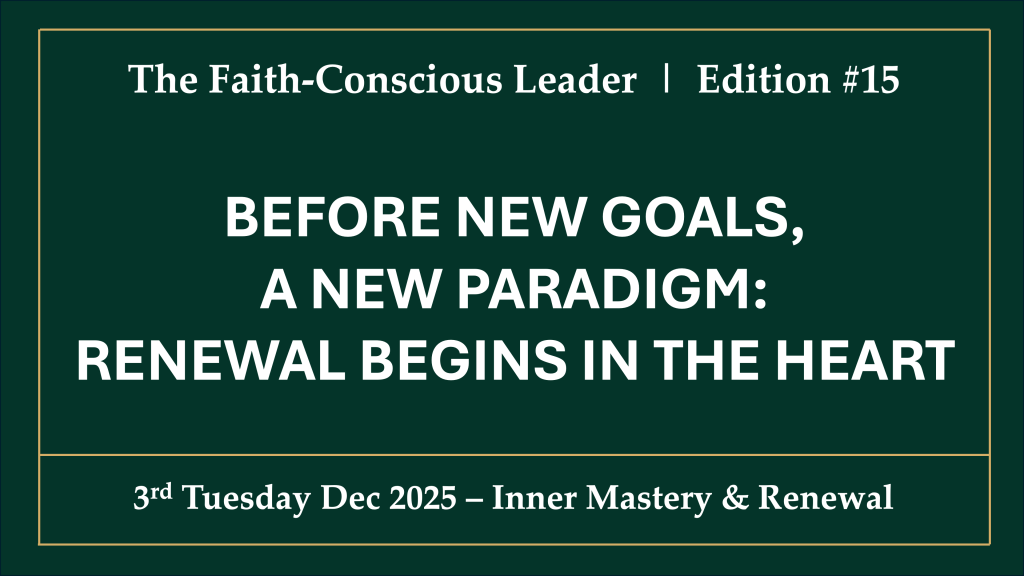
We review strategies, budgets and calendars. This ritual is familiar and necessary. Yet experience suggests that renewal rarely succeeds when it begins with plans alone.
Sustainable renewal begins with a shift in paradigm.
A paradigm is an assumption or mental model through which we see ourselves, others and the world around us.
It shapes what we notice, how we interpret events and what we believe is possible. In leadership, paradigms quietly influence decisions, energy and behaviour long before any strategy is written down.
In my work as a CEO coach, I often meet capable leaders who feel stuck despite having skills, experience and good intentions.
The obstacle is rarely a lack of knowledge or effort. More often, it is an unexamined paradigm that keeps them operating within invisible limits.
That paradigm does not live in spreadsheets or frameworks. It lives in the heart.
Why the Heart Matters in Leadership Renewal
When we speak about the heart, we do not mean only the physical organ, though my own triple bypass surgery earlier this year certainly brought fresh appreciation for it.
In this context, the heart refers to the inner centre of perception, intention and meaning. It is where beliefs settle, where fears and hopes coexist and where trust or hesitation quietly form.
In the Islamic tradition, the heart (qalb) is central to human consciousness and moral orientation. It is described as the seat of understanding and discernment. When left unattended, distortions form gradually and become normalised.
The Prophet Muhammad (peace be upon him) said, “Indeed, in the body there is a piece of flesh. If it is sound, the whole body is sound. If it is corrupted, the whole body is corrupted. Truly, it is the heart.”
For leaders, this insight has practical consequences. Without inner clarity, outer change becomes short-lived or exhausting. Renewal that bypasses the heart eventually loses momentum.
Muhasabah: The Gateway to Paradigm Shifting
A powerful practice for inner renewal is muhasabah, or honest self-examination. It is a form of personal stocktaking that looks inward with truthfulness and compassion. It involves recognising patterns without self-attack, guilt or shame.
Muhasabah helps surface what is already shaping our actions, especially the habits and assumptions we have normalised.
For leaders, renewal requires asking a deeper question beneath performance metrics: How do I limit myself, and how can I stop? This question opens three layers of reflection.
Layer 1: Limiting Behaviours
Begin by identifying areas where results fall short of potential. These may involve leadership presence, health, relationships, confidence, consistency or courage.
Then observe behaviours that show up repeatedly under pressure. Write them down clearly, using verbs:
Avoiding difficult conversations
Overthinking instead of deciding
Staying busy to avoid reflection
Delaying action
Seeking approval without clarity
These behaviours are visible signs. They point toward something deeper.
Layer 2: Limiting Explanations
Behind repeated behaviour lies an internal narrative. These explanations often sound reasonable and protective:
“This is just how I am.”
“Now is not the right time.”
“Others wouldn’t understand.”
“I need to be realistic.”
Such stories preserve identity and reduce discomfort. Over time, they solidify into limiting beliefs. In coaching conversations, this is often where insight emerges. Leaders recognise that what appears as realism may actually be fear expressed in logical language.
Layer 3: The Core Paradigm
When we examine several limiting beliefs together, a pattern begins to appear. One dominant paradigm often holds them all together:
“I must not disappoint others.”
“I am responsible for everything.”
“If I slow down, I will fall behind.”
“My worth comes from performance.”
This core paradigm influences decisions, emotional tone and energy. It may have served a purpose earlier in life, helping someone succeed or survive. Yet what once protected us may now constrain us.
Renewal requires surfacing this paradigm with honesty and gentleness.
Discovering the New Paradigm
Paradigm shifting begins internally. New behaviour follows naturally once the inner shift settles.
The key question becomes: What needs to shift inside the heart?
A new paradigm is usually a simple, grounding statement aligned with faith, responsibility and trust. It reframes how a leader relates to effort, control and outcomes.
Examples include:
“From control to trust”
“From proving to serving”
“From fear-driven effort to intention-led action”
“From self-reliance to reliance on god alongside effort”
When leaders articulate and internalise a new paradigm, something changes. Energy lightens. Decisions feel calmer. Presence strengthens.
The Qur’an reminds us: “And whoever places their trust in Allah, then He is sufficient for him.” (65:3)
Renewal Before the New Year
As a new year approaches, it may be wise to pause before setting new goals. Clearing space in the heart first allows goals to be owned rather than forced, pursued with clarity rather than strain.
Muhasabah helps leaders see clearly. Paradigm shifting helps them move forward with steadiness. When the heart realigns, effort feels different and leadership becomes more grounded.
This is renewal that lasts.
You may wish to reflect quietly on these questions:
“Where am I underachieving relative to my potential?”
“What behaviours appear there consistently?”
“What explanations do I give myself?”
“What core paradigm is operating beneath them?”
“What new paradigm would better align with trust, responsibility and faith?”
A new year does not only require new plans. It requires a clearer heart. When the paradigm shifts within, results follow without force. Renewal begins there. InshaAllah.
Hasannudin Saidin, CEO Coach, Rubah Associates and can be reached at hasan@rubah.my
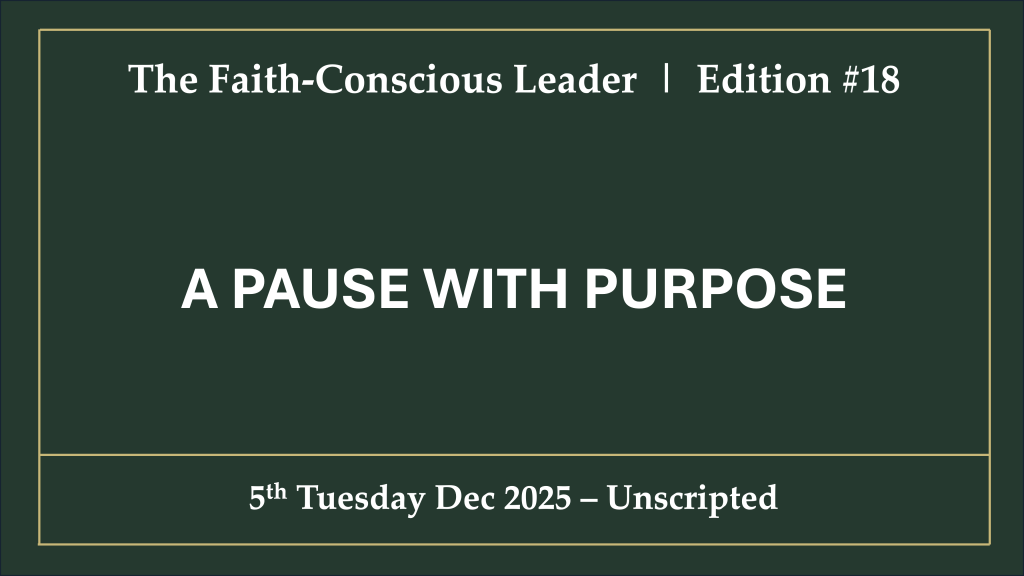
This is the eighteenth edition of The Faith-Conscious Leader.
I began this newsletter dreaming of some vague end. (“Let me get to 52 weeks first!”)
I did start with why.
Earlier this year, I emerged from a medical tribulation that slowed me down physically and inwardly. Reclamation (read: recovery) has a way of stripping away urgency and excess. What provoked me was a recurring question:
How do we lead, work and decide while remaining anchored in faith across everyday professional life?
This newsletter became a place for me to explore that question in public. I wrote as a learning practitioner reflecting in real time, shaped by coaching conversations, lived experiences and ongoing self-examination.
Writing weekly required steadiness, consistency, not to mention consumption of time! It required showing up with sincerity even when clarity was still forming. Over time, the writing became a discipline of attention and intention. Alhamdulillah (all praise and thanks be to Allah).
This final edition before a pause is a moment of stocktaking.
THE ARC OF THE JOURNEY
Looking back, these eighteen editions followed a progression that only became clear in hindsight.
The early editions focused on orientation.
I began by reflecting on leadership of the heart, identity and inner coherence. I explored how productivity systems, strategic language and professional frameworks influence behaviour and decision-making. Several editions examined how secular assumptions surreptitiously shape how we work, measure success and define effectiveness.
I deliberately went into application.
I explored faith-conscious productivity, bureaucratic realities, mission-driven strategy and leadership under pressure. I reflected on adversity through prophetic examples and personal experience, focusing on resilience, realism and responsibility.
The focus toggled outward-inward.
Several editions centred on stillness, emotional intelligence, renewal and purification of the heart. These reflections were grounded in conversations with leaders, community dialogues and personal struggle. They examined how emotional maturity shapes leadership presence and judgment.
The more recent editions moved assuredly into practice and structure.
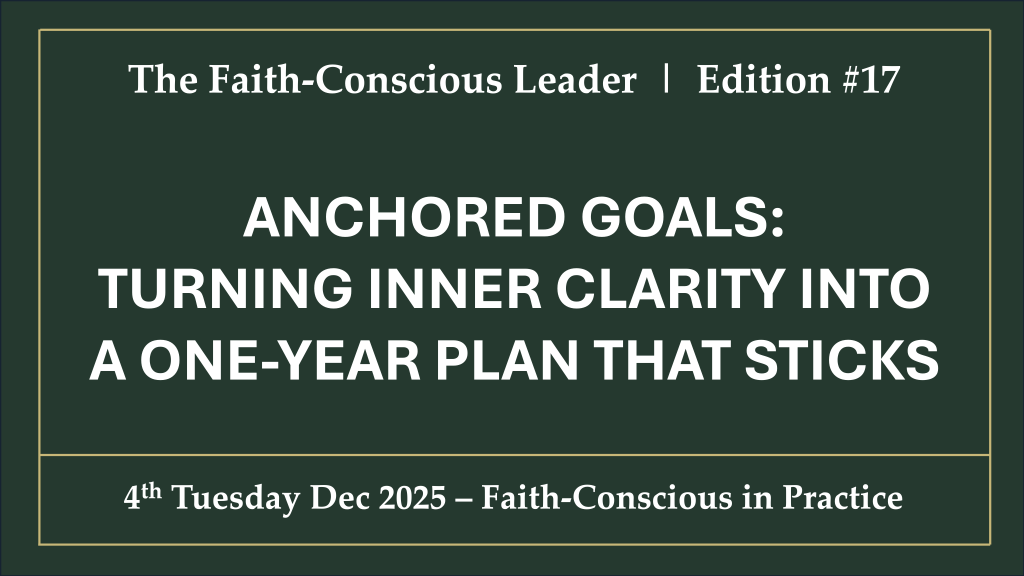
Stocktaking (muhasabah) was introduced as an inward leadership discipline. The Business Model Canvas was revisited through a faith-conscious perspective. Paradigm shifting was explored as a prerequisite for renewal. Most recently, Anchored Goals translated inner clarity into a one-year planning structure grounded in roles, focus and steady review.
That most recent edition forms an important part of this journey. It connected renewal of the heart with practical goal-setting and showed how clarity can be sustained across twelve months through simple, repeatable practices.
Taken together, the editions traced a movement:
awareness
responsibility
reflection
renewal
structure
This sequence reflects how change unfolds in real leadership life.
– A faith-conscious goal setting for leaders seeking focus, steadiness and follow-through
FROM PARADIGM TO PRACTICE
In the previous edition, we explored how renewal begins with a paradigm shift in the heart. That inner shift matters because it determines what we choose to pursue, how we pursue it and how we respond when circumstances change.
This edition moves from inner clarity to practical structure.
Once the heart realigns, a natural question follows:
How do I translate this clarity into goals that guide my year without overwhelming me?
This is where the concept I call Anchored Goals comes in.
It is a way of setting goals that reflects the life we are actually living, the responsibilities we carry and the capacity we realistically have over twelve months.
WHY GOALS DRIFT WITHOUT ANCHORS
Many professionals set goals every year. Fewer feel guided by them.
From my coaching experience, goals tend to lose relevance when they are created without sufficient regard for the roles we live in daily, the energy each role requires and the emotional centre of the year.
When goals float without anchors, attention fragments, review becomes irregular and commitment weakens gradually.
Allah reminds us:
“So remain on a right course as you have been commanded…” — Qur’an 11:112
Anchored Goals begins by restoring structure and proportion, then shaping goals that fit within that reality.
STEP 1: CLARIFY THE ROLES YOU WILL BE PLAYING IN THE COMING YEAR
Before defining goals, we need to recognise the roles we already inhabit.
A role is an ongoing responsibility, not a glamorous title for status. It represents something that calls on your time, attention and emotional presence throughout the year.
Some roles are steady and do not require specific goals. Some have been neglected. Some are emerging.
Examples of roles leaders often carry include:
leader (CEO or senior executive)
entrepreneur or business owner
professional (manager, consultant, coach, facilitator)
spouse
parent
extended family member
learner
contributor to community
servant of Allah
self-caretaker
Make it deliberate to include self-caretaker as a role. Leaders often deprioritise health, renewal and inner development. Naming this role restores balance.
Limit your list to no more than eight roles. Combine or simplify where needed.
Then reflect:
Which roles currently receive most of my energy?
Which roles are under-attended?
Which roles will become more significant this coming year?
This step restores perspective. It allows us to see life as an integrated system rather than a collection of disconnected goals.
– How muhasabah (self-examination, stocktaking) helps leaders uncover self-limiting patterns and renew direction for the year ahead
WHY RENEWAL REQUIRES A PARADIGM SHIFT
It is December. As the year draws to a close, or when the new year has set in, many leaders reflect on goals, plans and targets for the year ahead. We review strategies, budgets and calendars. Yet I don’t recommend renewal to begin with plans alone.
It should begin with a paradigm shift!
The word paradigm is commonly used in leadership and strategy. It refers to an assumption, mindset or perception about yourself, someone else or a situation. It is the mental model through which we see the world. A paradigm shapes what we notice, how we interpret events and what we believe is possible.
“…Indeed, Allah will not change the condition of a people until they change what is within themselves…” — Qur’an 13:11
In my work as a CEO coach, I’ve observed that when leaders struggle to create results, they think the issue is lack of skill or effort. But then, the skills and knowledge they already have, are they really using them? Their efforts, how sincere are they about them?
What I see as the issue is a paradigm unconsciously holding them where they are.
And that paradigm does not live in spreadsheets or frameworks. It lives in the heart.
WHAT DO WE MEAN BY “HEART”?
When we speak about heart here, we do not necessarily mean the physical organ pumping the seen red blood, although an “overhaul” through my triple bypass surgery early this year did help! But then, beyond just being a pump, scientific research and physiological evidence suggest the heart plays an active role in mental and emotional processes.
In this article, we use heart to signify the inner centre of perception, intention and meaning. It is the “place” where beliefs settle. The place where fear, hope, trust and hesitation reside.
In the Islamic tradition, the heart (qalb) is central in the conception of the soul, not just an emotional organ but the pivot of consciousness and moral orientation. It is where understanding truly happens. It is also where distortions quietly form if left unexamined.
The Prophet ﷺ said:
“Indeed, in the body there is a piece of flesh. If it is sound, the whole body is sound. If it is corrupted, the whole body is corrupted. Truly, it is the heart.” — Hadith
This is why renewal for a new year must involve the heart. Without inner clarity, outer change becomes temporary or exhausting.
THE ROLE OF MUHASABAH IN PARADIGM SHIFTING
Muhasabah, or stocktaking, is the practice of honest self-examination. It includes truthful observation of pride (kibr), self-aggrandizement (ujub) or ostentation (riak), yet also without self-attack, guilt or shame.
It allows us to surface what is already shaping our actions, especially the patterns we have normalised.
For renewal to be real, muhasabah must go deeper than reviewing outcomes. It must address the question beneath performance:
CORE QUESTION: How do I limit myself and how can I stop?
– How inner awareness and heart purification shape leadership with excellence, fairness and compassion
PROPHETIC MODEL OF EMOTIONAL INTELLIGENCE
Leadership with ihsan (excellence) calls us to lead with beauty of conduct, fairness and compassion. It is outer excellence grounded in inner clarity. Technical skills help leaders perform, but with tension or uncertainty, what sustains leadership is emotional steadiness.
Emotional intelligence has become a central idea in modern leadership. Yet long before it was labelled, Prophet Muhammad ﷺ lived its highest form.
Javed describes emotional intelligence (I use the acronym EI here) as about controlling one’s feelings and emotions, placing them in the driver’s seat of decision-making and behaviour, rather than being controlled by them. It encompasses internal factors like self-awareness, self-regulation, and self-motivation, as well as external factors such as social skills and empathy.
What modern psychology teaches about EI is valuable. What our prophetic tradition teaches goes deeper.
The video excerpt below from the podcast episode exemplifies the heart of prophetic EI:
– Faith-Consciousizing a popular method of business model generation
BMC here refers to the Business Model Canvas. On a single canvas (page), you get to view nine building blocks of a business. Many strategists, consultants and entrepreneurs use it as a practical, visual tool to design and iterate their business model.
See it mentioned (with a twist) in this short video below, in a recent meetup of Faith-Conscious Professionals:
In this newsletter edition, I share (with George’s permission) the “Islamic BMC” template found in his course material and I attempt to interpret and discuss what it means to see the BMC through a faith-conscious lens.
I hope to participate in the entire Islamic Entrepreneurship masterclass in future. For now I revisit the BMC, requesting guidance from George, my other BMC mentors and readers here. I stand corrected, and welcome your comments so that my own BMC can be updated and refined, insha Allah.
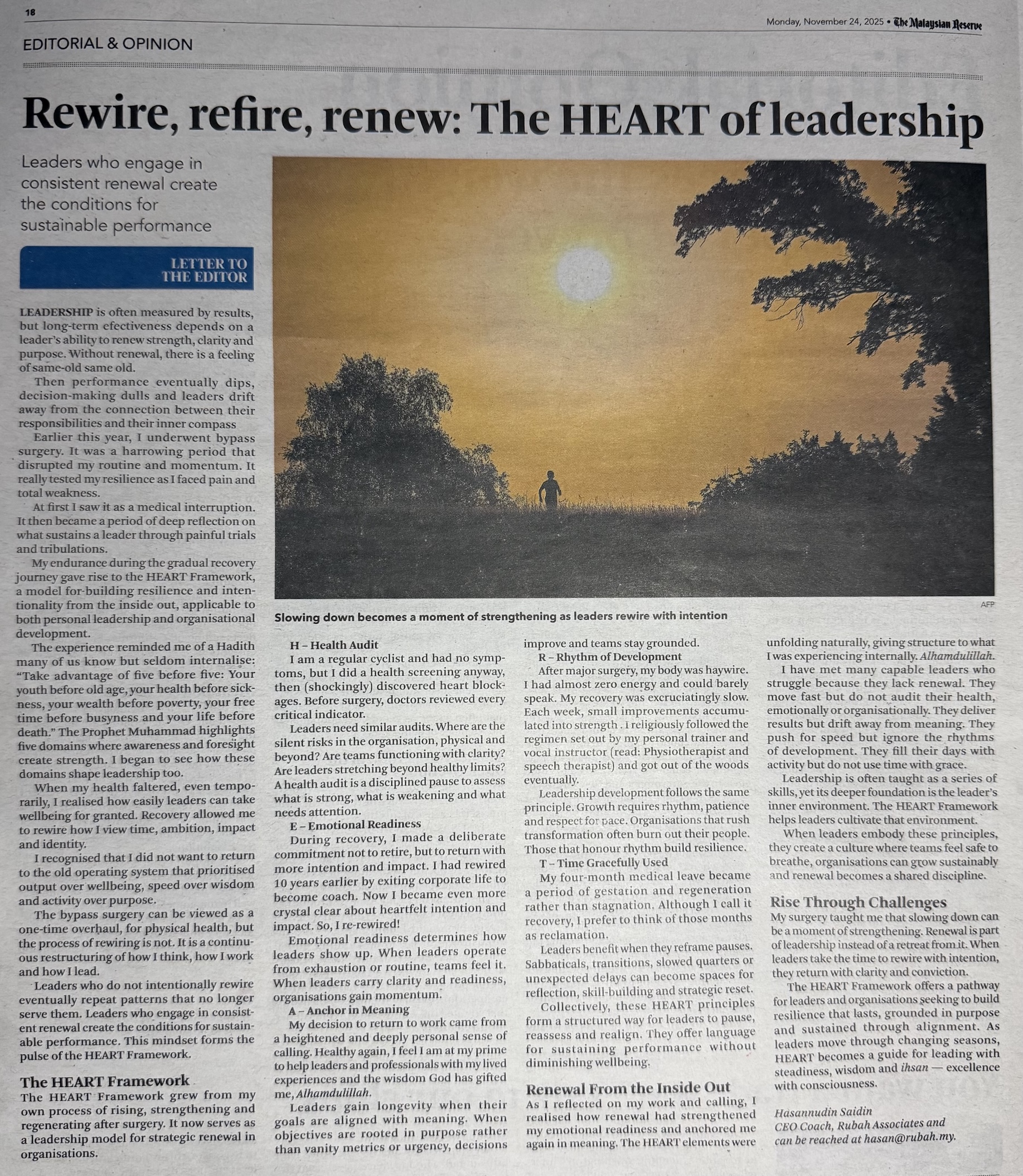
Slowing down becomes a moment of strengthening as leaders rewire with intention (Pic: AFP)
LEADERSHIP is often measured by results, but long-term effectiveness depends on a leader’s ability to renew strength, clarity and purpose. Without renewal, there is a feeling of same-old same old.
Then performance eventually dips, decision-making dulls and leaders drift away from the connection between their responsibilities and their inner compass.
Earlier this year, I underwent bypass surgery. It was a harrowing period that disrupted my routine and momentum. It really tested my resilience as I faced pain and total weakness.
At first I saw it as a medical interruption. It then became a period of deep reflection on what sustains a leader through painful trials and tribulations.
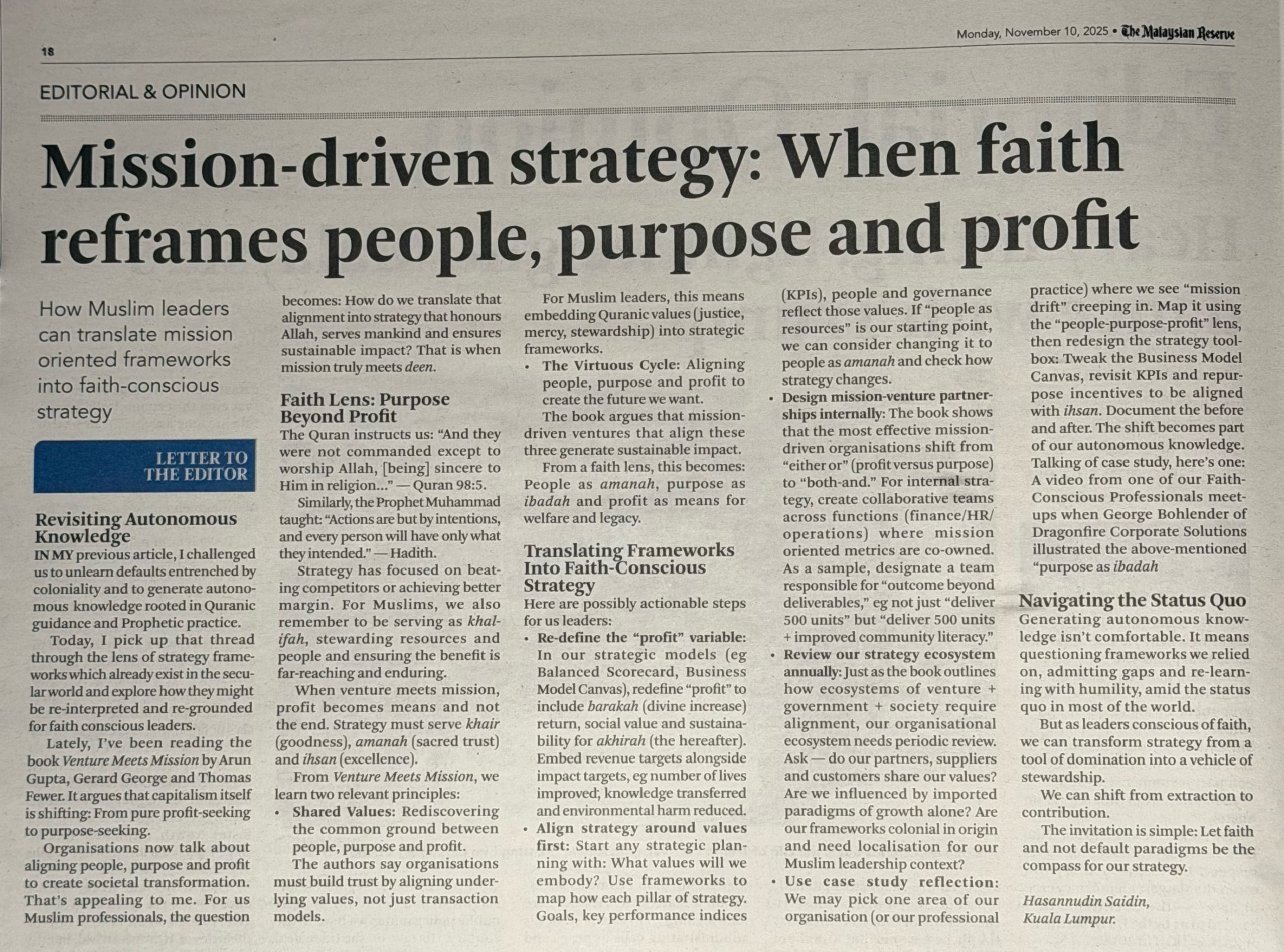
IN MY previous article, I challenged us to unlearn defaults entrenched by coloniality and to generate autonomous knowledge rooted in Quranic guidance and Prophetic practice.
Today, I pick up that thread through the lens of strategy frameworks which already exist in the secular world and explore how they might be re-interpreted and re-grounded for faith-conscious leaders.
Lately, I’ve been reading the book Venture Meets Mission by Arun Gupta, Gerard George and Thomas Fewer. It argues that capitalism itself is shifting: From pure profit-seeking to purpose-seeking.
Organisations now talk about aligning people, purpose and profit to create societal transformation. That’s appealing to me. For us Muslim professionals, the question becomes: How do we translate that alignment into strategy that honours Allah, serves mankind and ensures sustainable impact? That is when mission truly meets deen.
Alhamdulillah. I am grateful to share a meaningful milestone in my leadership journey.
Starting this month (November 2025), I am contributing fortnightly to The Malaysian Reserve (TMR), one of Malaysia’s respected business and financial newspapers. My articles appear in the print edition every other Monday, followed by the online version a few days later. (The print edition is weekly.)
This opportunity emerged naturally and unexpectedly, through conversations and sharings over the past months, especially after my bypass surgery earlier this year. That difficult period reshaped how I viewed purpose, resilience and the inner foundations of leadership. It also deepened my intention to write regularly and offer meaningful reflections to leaders navigating today’s complexities.
TMR’s readership consists of business leaders, policymakers, entrepreneurs, executives and professionals. I hope to bring value to them through practical insights shaped by lived experience, reflection, and the frameworks I have developed over the years.